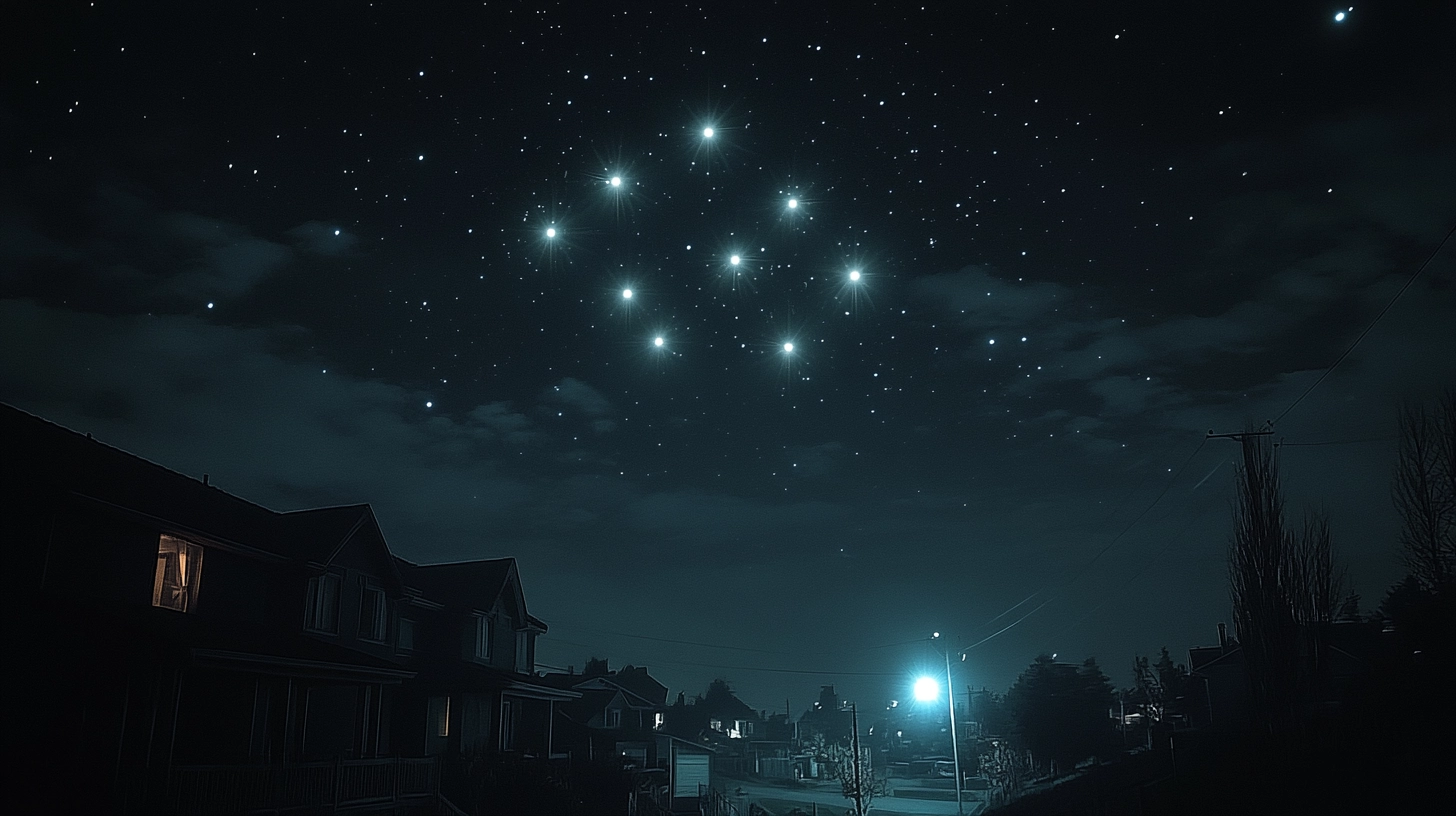
UAP Sightings Surge Across Europe — What Governments Are Saying
From Norway's Hessdalen lights to French GEIPAN files and British Ministry of Defence records, Europe has a long and largely suppressed UAP history that is slowly coming into the open.

A Continent's Quiet Reckoning
While American UAP discourse has dominated global headlines since the 2017 New York Times exposé, Europe's governments have been conducting their own quiet reckonings with the phenomenon — some for decades. The results are uneven: one country funds serious scientific investigation, another quietly shutters its programme and destroys the files, a third releases thousands of pages and says nothing more. What emerges is a picture of institutional ambivalence that mirrors, in its essential outlines, the American experience.
France: The Most Transparent Programme in the West
France's GEIPAN — the Group for Studies and Information on Unidentified Aerospace Phenomena — operates under the French space agency CNES and is arguably the most transparent government UAP investigation body in the world. Unlike its American counterparts, GEIPAN publishes its case files publicly. Its database contains thousands of reports dating back decades.
Of those cases, GEIPAN classifies a small but significant percentage as Category D: phenomena for which no explanation has been found despite thorough investigation. The French programme's value is not in its conclusions — it reaches few definitive ones — but in its methodology. GEIPAN applies scientific rigour to UAP investigation in a way that most other national programmes have explicitly avoided.
The 1981 Trans-en-Provence case remains GEIPAN's most celebrated investigation. Physical traces on the ground were analysed by multiple laboratories and found to be consistent with exposure to intense heat and electromagnetic radiation. The source was never identified.
Norway: Hessdalen and the Lights That Won't Cooperate
The Hessdalen Valley in central Norway has produced anomalous light phenomena consistently since the early 1980s. The lights — white, yellow, and red, appearing at various altitudes and exhibiting non-ballistic flight characteristics — have been documented by Norwegian scientists, filmed extensively, and subjected to more sustained scientific investigation than almost any other recurring UAP phenomenon.
Project Hessdalen, established in 1983, produced physical measurements including radar returns, laser ranging data, and spectroscopic analysis. The lights have measurable electromagnetic signatures. They are real in the most empirical sense — they interact with instrumentation, they have been photographed simultaneously from multiple locations, and they defy conventional explanation.
No consensus explanation exists. Proposed theories range from plasma formations to piezoelectric effects from the valley's geology. None fully accounts for the observed behaviour.
The United Kingdom: Disclosure and Erasure
Britain's relationship with its UAP history is one of the stranger bureaucratic stories in modern government. The Ministry of Defence operated a UAP desk — officially called the Unidentified Aerial Phenomena desk — for decades. It was closed in 2009 on the stated grounds that it served no defence purpose.
What happened to the files is contested. Some were transferred to the National Archives and are publicly accessible. Others were reportedly destroyed. Nick Pope, who ran the MoD's UFO desk from 1991 to 1994, has stated publicly that some of the most significant material was never released and that the decision to close the programme was not based on a finding that UAPs posed no threat — it was based on a decision that the subject was politically inconvenient.
The Rendlesham Forest incident of December 1980 — in which U.S. Air Force personnel at a joint British-American base reported a structured craft landing in a forest, physical ground traces, and radiation readings — remains in the National Archives. The MoD's conclusion was that it had no defence significance. The personnel who witnessed it have never agreed with that assessment.
What European Disclosure Looks Like
The European UAP picture is not a story of coordinated conspiracy. It is a story of bureaucratic reflexes — the same instinct toward classification, the same institutional reluctance to be associated with a subject treated as disreputable, the same pattern of investigation followed by suppression.
What distinguishes the European record is that fragments of it have survived where the American record has been more thoroughly managed. The French database is a model that no other country has matched. The Norwegian measurements are peer-reviewed. The British files, fragmentary as they are, exist.
The question being asked with increasing urgency on both sides of the Atlantic is the same: if the phenomenon is real — and the evidence is consistent with it being real — what does it mean that governments have spent seventy years learning as little about it as possible?